
Significance
9 measured / 9 eligible · 0 missing · 0 not applicable
score (0 to 1) · Event-level distribution, not a Situation risk score.
across all 9 events
On Oct. 4, German Chancellor Friedrich Merz visited Kyiv and pledged billions more in aid to Ukraine, as reported in “German Chancellor Merz visits Kyiv, pledges billions more in aid to Ukraine.” Germany provided Ukraine with weapons and energy support. Ukraine’s Defense Minister Yevheniy Khmara discussed stronger air defenses and weapons with Merz, and Volodymyr Zelensky pressed Merz for German Taurus missiles in Kyiv. Alice Weidel criticized Merz over the visit, while Kirill Dmitriev called him “Ukraine’s chancellor.” On Oct. 5, “Zelensky and Merz clash in Kyiv over Ukraine’s EU membership” reported a clash over EU membership in Kyiv; the connection links that Story to Merz’s visit.
Footnotes[2][4][3][5][8][7][6][1][13]The Oct. 4 events put material support and discussions of military aid and air defenses alongside Zelensky’s request for Taurus missiles; the aid event describes German support, while the visit story says Merz pledged billions more. Weidel’s and Dmitriev’s criticisms add distinct political reactions, not evidence of a change in German policy. The Oct. 5 headline reports an EU-membership clash, but that Story has no linked coded Event in the Oct. 5 timeline. Together, the headlines and Events establish the visit’s aid and diplomatic themes, but do not establish the outcome of the missile request or the substance of the reported EU-membership disagreement.
Footnotes[4][2][5][8][7][6][1][12]Explanation originally captured 2026-10-05 · Evidence through 2026-10-05 UTC · Source edition sed_764f39e295ac9da8fbddf571e0f63741
A 2-day Situation represented by 9 coded Events carried across 5 member Stories.
The coded activity is led by 111 · Criticize or Denounce (2) and 0232 · Military (1).
Friedrich Merz and Volodymyr Zelenskyy are prominent in the retained actor and relationship evidence.
38 canonical Entities are linked to this edition.
Metric coverage. 9 coded Events · 9 CAMEO+ · 0 conflict. The four dimensions describe the CAMEO+ subset; conflict Events do not carry these scores.
Dot = mean · shaded span = observed range · position uses each metric’s defined scale.
How the coder scored the full retained Event set
9 coded events — 9 CAMEO+ (8 political)
Quad class over those 8 events · Verbal Cooperation 4 · Verbal Conflict 3 · Material Cooperation 1. No conflict-family event here, so nothing carries a fatality count — a missing column, not a toll of zero. 1 sit outside POLITICAL, where Goldstein and quad class are undefined.
9 measured / 9 eligible · 0 missing · 0 not applicable
score (0 to 1) · Event-level distribution, not a Situation risk score.
across all 9 events
9 measured / 9 eligible · 0 missing · 0 not applicable
score (0 to 10) · Event-level distribution, not a Situation risk score.
across all 9 events — every one of them CAMEO+
9 measured / 9 eligible · 0 missing · 0 not applicable
score (0 to 1) · Event-level distribution, not a Situation risk score.
across all 9 events — every one of them CAMEO+
9 measured / 9 eligible · 0 missing · 0 not applicable
score (0 to 1) · Event-level distribution, not a Situation risk score.
across all 9 events — every one of them CAMEO+
9 measured / 9 eligible · 0 missing · 0 not applicable
score (0 to 1) · Event-level distribution, not a Situation risk score.
across all 9 events — every one of them CAMEO+
8 measured / 8 eligible · 0 missing · 1 not applicable
score (-10 to 10) · Event-level distribution, not a Situation risk score.
across the 8 of 9 events Goldstein is defined on — CAMEO+ POLITICAL and the conflict family; the other nine CAMEO+ domains have no Goldstein semantics
9 measured / 9 eligible · 0 missing · 0 not applicable
score (0 to 1) · Event-level distribution, not a Situation risk score.
across all 9 events
This retained edition, independent of graph and page limits. Different dimensions, not a blended risk score; reported tolls may overlap.
2026-10-05analystlatest
EU-membership disagreement reported
The Story “Zelensky and Merz clash in Kyiv over Ukraine’s EU membership” is dated Oct. 5; the Oct. 5 timeline lists no linked coded Event.
What kind of event · 8 coded types
over 9 coded events on this edition
Countries · where it happened
Countries · who is acting
Selected from the complete retained edition
The visit and German support are the core; the Khmara discussion is described as part of the same incident, and the EU-membership Story is linked to the visit as reporting a discussion during it.
Friedrich Merz was the target of Zelensky’s Taurus-missile appeal and of criticism from Alice Weidel and Kirill Dmitriev; he also appears in the visit and Khmara-discussion Stories.

The Event describes Germany providing Ukraine with weapons and energy support, alongside the visit story’s report that Merz pledged billions more in aid.

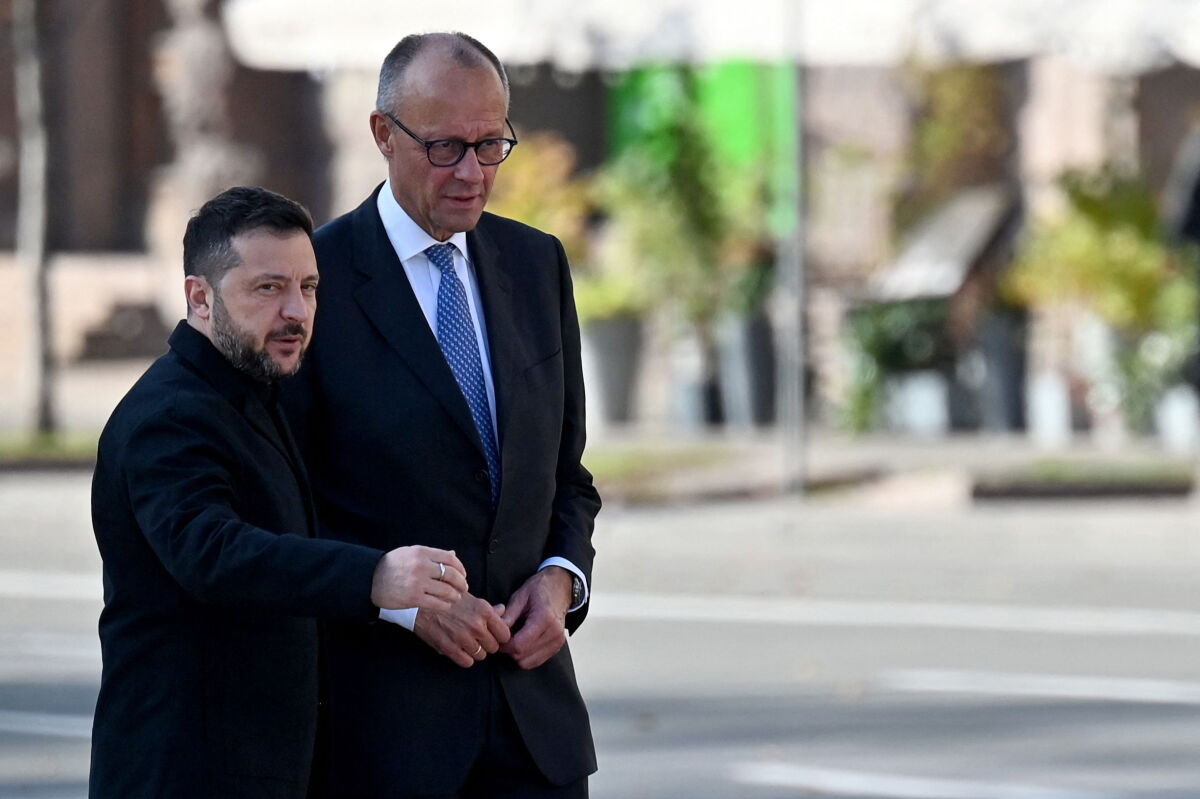
Evidenced relationships involving significant participants beyond the central cast.
The Stories are linked as the same incident.
The Stories are linked as the same incident.
Footnotes[14]The connection describes the later Story as reporting a discussion during the visit.
The connection describes the later Story as reporting a discussion during the visit.
Footnotes[13]This edition freezes the complete served membership and analysis available through its UTC cutoff. Later repairs or identity changes do not rewrite what this edition showed.
Stories are reporting clusters. Events are coded occurrences within that reporting. The cast contains 38 canonical people and organizations linked to the retained evidence.
Story-to-Event edges identify supporting reporting. Entity-to-Event edges identify recorded actor or target participation. Mentions and analytical roles stay visibly distinct from recorded participation.
Core, precursor, and continuation labels organize the reading. They do not by themselves establish causation. Collapsed graph groups and paginated evidence change presentation only; counts use the complete retained edition.