
Significance
94 measured / 94 eligible · 0 missing · 0 not applicable
score (0 to 1) · Event-level distribution, not a Situation risk score.
across all 94 events
On September 3, Joseph Aoun denounced Israeli attacks and backed UNIFIL in “Joseph Aoun denounces Israeli attacks in south Lebanon, backs UNIFIL.” On September 4, the Israel Defense Forces seized the Ali al-Taher ridge from Hezbollah; the September 5 Story “Israel says it completes control of southern Lebanon’s security zone via Ali Taher crest” attributed a broader control claim to Israel. On September 8, the Kfar Remman raid Event reported ten fatalities, including eight civilians, while the UN chief urged Israel to withdraw from southern Lebanon. On September 24, the Israel Defense Forces reduced their troop presence; Nawaf Salam called for withdrawal from Lebanese territory on September 25. On October 8, Aoun said talks could end hostility and told Kaja Kallas that the Lebanese Army was fulfilling its duties. On October 19, Aoun accused Israel of violating the US-mediated framework and committed Lebanon to a diplomatic solution; on October 20, the Israel Defense Forces criticized the Lebanese Army over a weapons site, and the Army rejected Israeli claims about its operations. Coverage published October 23 said Tampa talks had pushed for a military liaison office; other coverage said the talks ended without a breakthrough, and the reports do not establish that an office was created.
Footnotes[24][14][20][13][15][12][19][11][17][9][18][27]The September 4 ridge-seizure Event establishes Israeli activity at Ali al-Taher. A separate September 5 Event records a reduction of the security zone, while the September 5 Story headline attributes a broader claim of completed control to Israel; these records do not establish the full extent of Israeli control. A September 11 report said Israeli forces withdrew from the Ali al-Taher heights. The September 24 troop reduction does not establish a full withdrawal from southern Lebanon, and Salam’s call for withdrawal is a demand, not an accomplished withdrawal. Aoun’s diplomatic statements and his accusation of framework violations establish his stated positions, not a settlement or compliance. The Israel Defense Forces’ criticism of the Lebanese Army and the Army’s rejection remain competing accounts; neither establishes whether the Army fulfilled its duties or disarmed Hezbollah. Discussion of a military liaison office establishes a negotiation topic, not that an office was created.
Footnotes[20][13][17][18][27][21][23][26][16]Explanation originally captured 2026-10-24 · Evidence through 2026-10-24 UTC · Source edition sed_1d292d05a0f81c687e11a04f83938162
A 53-day Situation represented by 94 coded Events carried across 336 member Stories.
The coded activity is led by AIR/DRONE STRIKE (27) and 01 · Make Public Statement (10).
Israel Defense Forces, Hezbollah, and Joseph Aoun are prominent in the retained actor and relationship evidence.
258 canonical Entities are linked to this edition.
Metric coverage. 94 coded Events · 42 CAMEO+ · 52 conflict. The four dimensions describe the CAMEO+ subset; conflict Events do not carry these scores.
Dot = mean · shaded span = observed range · position uses each metric’s defined scale.
How the coder scored the full retained Event set
94 coded events — 42 CAMEO+ (41 political) · 52 conflict
Quad class over those 93 events · Material Conflict 50 · Verbal Cooperation 25 · Verbal Conflict 16 · Material Cooperation 2. 1 sit outside POLITICAL, where Goldstein and quad class are undefined. The four CAMEO+ scores are over the 42 CAMEO+ events only; the 52 conflict events have no such column.
94 measured / 94 eligible · 0 missing · 0 not applicable
score (0 to 1) · Event-level distribution, not a Situation risk score.
across all 94 events
42 measured / 42 eligible · 0 missing · 52 not applicable
score (0 to 10) · Event-level distribution, not a Situation risk score.
across the 42 of 94 events coded in the CAMEO+ family; the conflict family has no such column
42 measured / 42 eligible · 0 missing · 52 not applicable
score (0 to 1) · Event-level distribution, not a Situation risk score.
across the 42 of 94 events coded in the CAMEO+ family; the conflict family has no such column
42 measured / 42 eligible · 0 missing · 52 not applicable
score (0 to 1) · Event-level distribution, not a Situation risk score.
across the 42 of 94 events coded in the CAMEO+ family; the conflict family has no such column
42 measured / 42 eligible · 0 missing · 52 not applicable
score (0 to 1) · Event-level distribution, not a Situation risk score.
across the 42 of 94 events coded in the CAMEO+ family; the conflict family has no such column
93 measured / 93 eligible · 0 missing · 1 not applicable
score (-10 to 10) · Event-level distribution, not a Situation risk score.
across the 93 of 94 events Goldstein is defined on — CAMEO+ POLITICAL and the conflict family; the other nine CAMEO+ domains have no Goldstein semantics
52 measured / 52 eligible · 0 missing · 42 not applicable
reported people · Reports may overlap; these are Event-level reports, not an additive unique human toll.
across the 52 of 94 events that report a toll — the conflict family only, and never 0 on a CAMEO+ event
94 measured / 94 eligible · 0 missing · 0 not applicable
score (0 to 1) · Event-level distribution, not a Situation risk score.
across all 94 events
This retained edition, independent of graph and page limits. Different dimensions, not a blended risk score; reported tolls may overlap.
2026-10-23from the recordslatest
Lebanon and Israel discuss a military liaison office in Tampa
2 Stories and 1 coded Event (-2 / +1 against the day before). Widest coverage: Tampa talks push Lebanon and Israel to establish military liaison office (2 articles). Recorded acting: Israel.
What kind of event · 36 coded types
over 94 coded events on this edition
Countries · where it happened
Countries · who is acting
Selected from the complete retained edition
The Ali al-Taher ridge seizure and the later troop reduction are distinct developments; neither establishes the extent of wider territorial control or a full withdrawal.
Salam called for Israeli withdrawal, while Aoun said the Lebanese Army was fulfilling its duties; the Israel Defense Forces later criticized the Army, and the Army rejected Israeli claims about its operations.
The UN chief urged Israel to withdraw, Aoun endorsed talks, and Salam appealed to Jean-Noël Barrot to prevent a security vacuum in southern Lebanon.
The Israel Defense Forces seized the Ali al-Taher ridge, reduced their troop presence in southern Lebanon, and criticized the Lebanese Army over a weapons site.

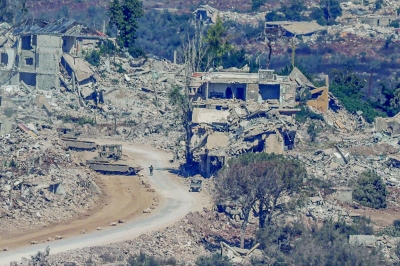

On September 24, the Israel Defense Forces reduced their troop presence in southern Lebanon; the Story headline specifies a reduction from eight brigades to six.
Evidenced relationships involving significant participants beyond the central cast.
The Event names the Israel Defense Forces as its actor.
The Event names the Israel Defense Forces as its actor.
Footnotes[20]The Event names Hezbollah as its target.
The Event names Hezbollah as its target.
Footnotes[20]The Event names the Israel Defense Forces as its actor.
The Event names the Israel Defense Forces as its actor.
Footnotes[23]The Event names the Israel Defense Forces as its actor.
The Event names the Israel Defense Forces as its actor.
Footnotes[23]The headline attributes a broader security-zone control claim than the Event establishes at the ridge.
This edition freezes the complete served membership and analysis available through its UTC cutoff. Later repairs or identity changes do not rewrite what this edition showed.
Stories are reporting clusters. Events are coded occurrences within that reporting. The cast contains 258 canonical people and organizations linked to the retained evidence.
Story-to-Event edges identify supporting reporting. Entity-to-Event edges identify recorded actor or target participation. Mentions and analytical roles stay visibly distinct from recorded participation.
Core, precursor, and continuation labels organize the reading. They do not by themselves establish causation. Collapsed graph groups and paginated evidence change presentation only; counts use the complete retained edition.