
Significance
122 measured / 122 eligible · 0 missing · 0 not applicable
score (0 to 1) · Event-level distribution, not a Situation risk score.
across all 122 events
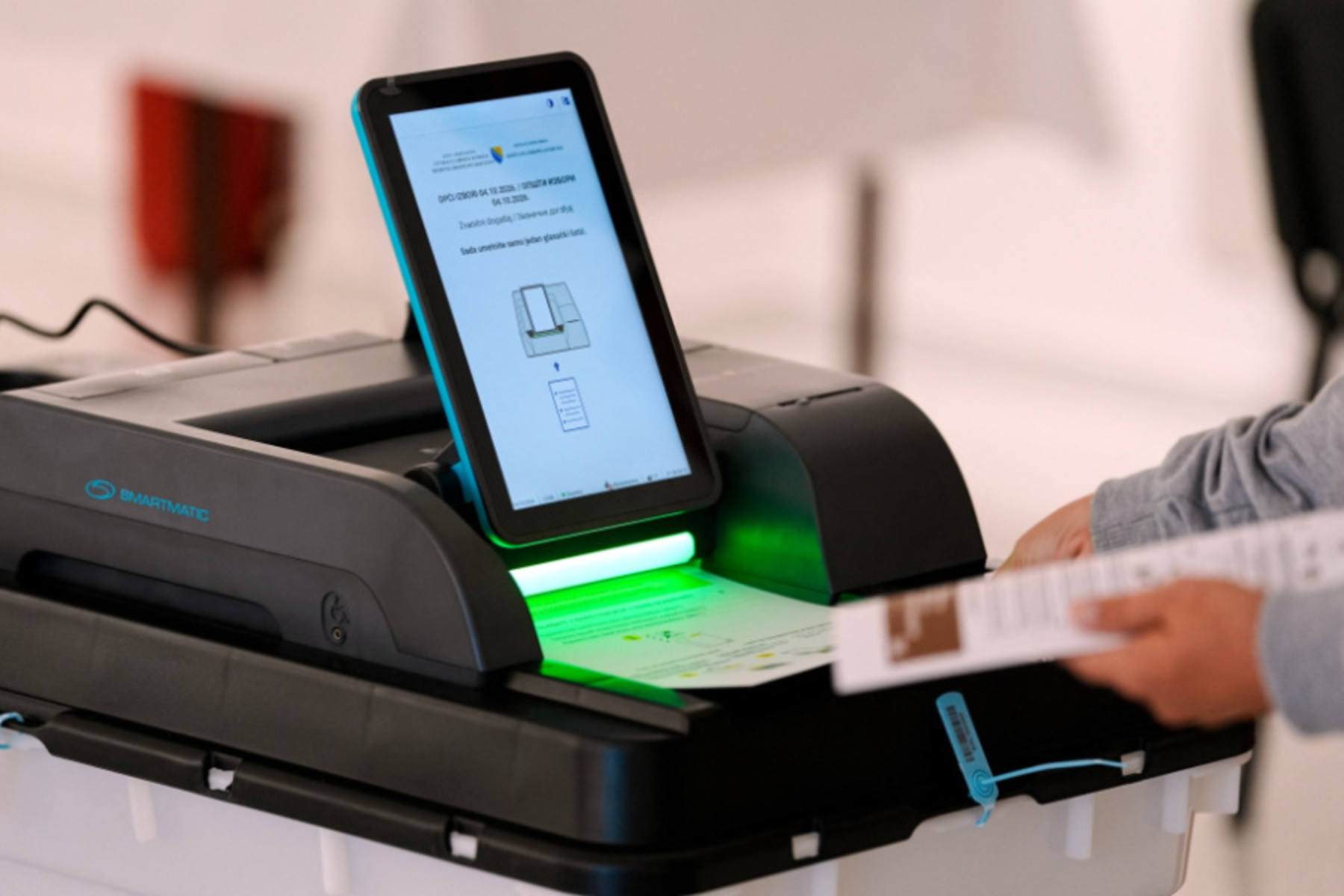
Bosnia and Herzegovina voted on 4 October; the Central Election Commission reported Salkić and Begić leading in Republika Srpska contests, while Bijeljina election officials reported technology problems at 184 polling stations in “Bosnia and Herzegovina opens polling stations for 2026 general elections.” (The first report and the problems were separate findings.) On 5 October, Denis Bećirović and other candidates declared victory in “Dodik declares victory as nationalist parties dominate Bosnia election”; those declarations were claims, not certified results. On 6 October, the European Union urged Bosnia’s leaders to accelerate reforms and form a government. On 7 October, the Commission updated Minić and Blanuša’s vote totals. These were separate developments; later reports said diaspora votes moved Balukčić ahead of Begić in the Republika Srpska vice-presidential race. Bargaining then proceeded on distinct tracks: SDA began talks with DF, SBiH and HDZ BiH in Zenica-Doboj Canton on 9 October, while Milorad Dodik and Dragan Čović met in Banja Luka on 12 October, as described in “SNSD and HDZ delegations meet in Banja Luka to discuss forming government.” On 19 October, SDA held talks with parties opposed to Trojka, with reports describing a near coalition deal; the next day, Željko Komšić ruled out an alliance with SDP. SDA, DF, POMAK and SBiH began separate government talks in Una-Sana Canton on 22 October. On 23 October, a report said postal votes shifted an FBiH parliamentary seat from SDA to HDZ. By 24 October, accounts said election results confirmed lawmakers but left…
Footnotes[55][40][30][27][56][37][24][57][45][36][43][22]The election accounts describe distinct stages: election-day standings, candidates’ victory declarations, preliminary Presidency results, and subsequent tally updates. The Commission reported preliminary Presidency results on 5 October and a separate Bećirović–Izetbegović tally update on 6 October, before its 7 October update to Minić and Blanuša’s totals. These reports do not make the early declarations equivalent to certified results, and the Presidency-vote account is distinct from the Minić–Blanuša update. Political contact and negotiation are also not proof of an agreed national government: the Zenica-Doboj talks, the Dodik–Čović meeting, SDA’s talks with anti-Trojka parties, and the competing claims about potential Sarajevo Canton arrangements concern different discussions or levels of government. The later Una-Sana talks are likewise a separate canton-level track. The developments establish active bargaining and competing positions, not a formed national government.
Footnotes[40][45][37][21][18][15][6][9][4][3][1][2]Explanation originally captured 2026-10-25 · Evidence through 2026-10-26 UTC · Source edition sed_71bc7944000674acb4d7c2c2f0f41267
A 27-day Situation represented by 122 coded Events carried across 182 member Stories.
The coded activity is led by 01 · Make Public Statement (48) and 02 · Appeal (10).
Central Election Commission of Bosnia and Herzegovina, Milorad Dodik, and European Union are prominent in the retained actor and relationship evidence.
292 canonical Entities are linked to this edition.
Metric coverage. 122 coded Events · 120 CAMEO+ · 2 conflict. The four dimensions describe the CAMEO+ subset; conflict Events do not carry these scores.
Dot = mean · shaded span = observed range · position uses each metric’s defined scale.
How the coder scored the full retained Event set
122 coded events — 120 CAMEO+ (118 political) · 2 conflict
Quad class over those 120 events · Verbal Cooperation 94 · Verbal Conflict 16 · Material Conflict 7 · Material Cooperation 3. 2 sit outside POLITICAL, where Goldstein and quad class are undefined. The four CAMEO+ scores are over the 120 CAMEO+ events only; the 2 conflict events have no such column.
122 measured / 122 eligible · 0 missing · 0 not applicable
score (0 to 1) · Event-level distribution, not a Situation risk score.
across all 122 events
120 measured / 120 eligible · 0 missing · 2 not applicable
score (0 to 10) · Event-level distribution, not a Situation risk score.
across the 120 of 122 events coded in the CAMEO+ family; the conflict family has no such column
120 measured / 120 eligible · 0 missing · 2 not applicable
score (0 to 1) · Event-level distribution, not a Situation risk score.
across the 120 of 122 events coded in the CAMEO+ family; the conflict family has no such column
120 measured / 120 eligible · 0 missing · 2 not applicable
score (0 to 1) · Event-level distribution, not a Situation risk score.
across the 120 of 122 events coded in the CAMEO+ family; the conflict family has no such column
120 measured / 120 eligible · 0 missing · 2 not applicable
score (0 to 1) · Event-level distribution, not a Situation risk score.
across the 120 of 122 events coded in the CAMEO+ family; the conflict family has no such column
120 measured / 120 eligible · 0 missing · 2 not applicable
score (-10 to 10) · Event-level distribution, not a Situation risk score.
across the 120 of 122 events Goldstein is defined on — CAMEO+ POLITICAL and the conflict family; the other nine CAMEO+ domains have no Goldstein semantics
2 measured / 2 eligible · 0 missing · 120 not applicable
reported people · Reports may overlap; these are Event-level reports, not an additive unique human toll.
across the 2 of 122 events that report a toll — the conflict family only, and never 0 on a CAMEO+ event
122 measured / 122 eligible · 0 missing · 0 not applicable
score (0 to 1) · Event-level distribution, not a Situation risk score.
across all 122 events
This retained edition, independent of graph and page limits. Different dimensions, not a blended risk score; reported tolls may overlap.
2026-10-25from the recordslatest
Unidentified assailants attack election officials in Doljevac
7 Stories and 4 coded Events (+4 / +3 against the day before). Widest coverage: Bosnia's Federation Parliament: full list of lawmakers awarded compensatory seats (13 articles). Recorded acting: Central Election Commission of Bosnia and Herzegovina.
What kind of event · 34 coded types
over 122 coded events on this edition
Countries · where it happened
Countries · who is acting
Selected from the complete retained edition
Election-day standings and polling problems were followed by victory declarations, subsequent tally updates and later accounts confirming lawmakers while leaving one seat vacant.
Party leaders and parties held talks and stated differing positions about possible partners; the accounts do not establish an agreed national government.
Bandić claimed SDA, SBiH and DF could form a Sarajevo Canton government; later accounts described a reported accord and a possible procedural obstacle.
SDS expelled Ljubiša Petrović; five Bijeljina councilors called for Blanuša to resign, while Blanuša said resignation had not been discussed.
Election officials reported technology problems; separate accounts described voter-integrity concerns and the OSCE Mission’s response to election findings.
The Central Election Commission reported Salkić and Begić leading the Republika Srpska race and later updated Minić and Blanuša’s vote totals.

On 4 October, the Central Election Commission reported Salkić and Begić leading the Republika Srpska race in “Bosnia and Herzegovina opens polling stations for 2026 general elections.”
On 4 October, Bijeljina election officials reported technology problems at 184 polling stations in “Bosnia and Herzegovina opens polling stations for 2026 general elections.”

On 5 October, candidates including Denis Bećirović declared victory in “Dodik declares victory as nationalist parties dominate Bosnia election.”
On 7 October, the Central Election Commission updated Minić and Blanuša’s vote totals in “Bosnia election commission puts Minić’s lead over Blanuša above 57,000 votes.”
Evidenced relationships involving significant participants beyond the central cast.
The Event names the Commission as the actor making the report.
The Event names the Commission as the actor making the update.
The Story supports the account of the meeting, not a concluded government agreement.
This edition freezes the complete served membership and analysis available through its UTC cutoff. Later repairs or identity changes do not rewrite what this edition showed.
Stories are reporting clusters. Events are coded occurrences within that reporting. The cast contains 292 canonical people and organizations linked to the retained evidence.
Story-to-Event edges identify supporting reporting. Entity-to-Event edges identify recorded actor or target participation. Mentions and analytical roles stay visibly distinct from recorded participation.
Core, precursor, and continuation labels organize the reading. They do not by themselves establish causation. Collapsed graph groups and paginated evidence change presentation only; counts use the complete retained edition.