
Atlas — geopolitical indices from GDELT Cloud coded events
Atlas · experimental
2 of 5 layers serve data. The rest are designed, not mocked up.
- Computed from events we code ourselves
- Vintaged point-in-time, no look-ahead
- Below the coverage floor: null, never a guess
- Baselines provisional since March 2026
GPR — Geopolitical Risk
Live · experimentalIs this place unusually tense for itself, right now?
How to read it
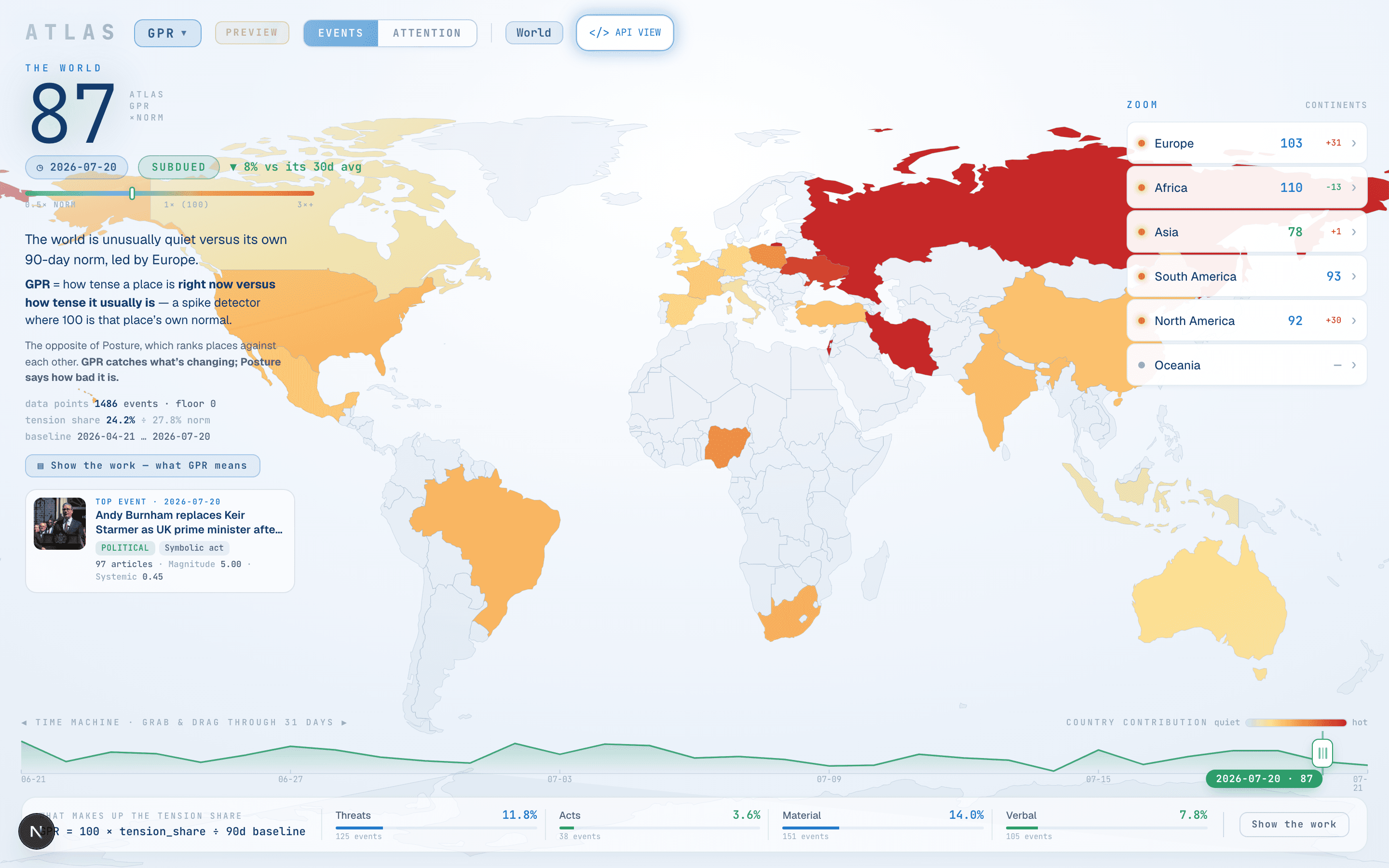
100 is a place’s own recent norm. 130 means it is running about 1.3× its own typical level of tension — not that it is 30% more dangerous than anywhere else.
The formula
GPR = 100 × (tension share today ÷ that place’s own baseline tension share)A real reading
On 2026-07-20 the world read 87: 24.2% of coded activity was tension-bearing against a 27.8% norm, so the world was about 13% quieter than usual. Europe read 103 the same day — dead normal for Europe.
Two ways to run it
Events
Built from coded events. Tension is the share of a place’s coded activity that is threat-bearing — threats and force posture — or an act already carried out: battles, explosions and remote violence, violence against civilians. This is the lens that drills to the incident.
Attention (narrative)
Built from clustered stories, weighted by how many articles carry them. Deliberately event-independent, so it still reads where coverage is thick but codeable events are thin — and it is the lens closest to the original newspaper-based GPR.
How ours differs
- Tension comes from structured event classes we coded, not keyword matching over newspaper text.
- One multilingual pipeline, so a country is measured the same way whatever language covers it.
- Hourly rather than monthly — and every reading drills to the story or event driving it.
- Below a coverage floor the reading is withheld as null, never rounded to a comfortable number.
- A band is a promise about how often a reading is unusual, so where the reference distribution is too flat to keep that promise the band is withheld too — the number still serves, the label does not.
- What it is not
- A probability. A high GPR says a place is behaving unusually for itself, not that a specific thing will happen — which is why it ships beside Posture rather than alone.
From GDELT Cloud
- Coded events — CAMEO+ domains and root codes, ACLED-style event types
- Per-event Goldstein, magnitude, systemic importance, propagation, market sensitivity
- Clustered stories with article counts, for the Attention lens
- Actor geography, so an event counts for the places involved and not only where it happened
From open feeds
- World Bank WDI — GDP, as the optional weighting for continent, region and world roll-ups
Frameworks it draws on
- GPR — Caldara & Iacoviello (Federal Reserve, AER 2022)
- The anchor. Share-of-coverage tension normalised to 100 at a long-run average, split into Threats and Acts. We take the whole shape and compute both halves from coded event classes instead of proximity word searches.
- EPU — Baker, Bloom & Davis (QJE 2016)
- Where the roll-up weighting comes from: EPU builds its global index as a GDP-weighted mean, which is why GDP weighting exists here as an option at all.
- WUI — Ahir, Bloom & Furceri (IMF)
- The single-uniform-instrument argument: measure every country with exactly the same instrument, or cross-country comparison means nothing.
- BGRI — BlackRock
- Keeps machine-measured attention strictly separate from human judgement about likelihood. We publish the attention half and do not dress it up as a probability.
Where it stands today
World and continent readings update daily and are the scopes we would build on. Country readings publish where coverage supports them and are withheld where it does not, so treat country as preview. Baselines sharpen as history accrues — the coded record starts in March 2026.
Posture — Country condition
Live · experimentalWhat state is this place actually in, next to everywhere else?
How to read it
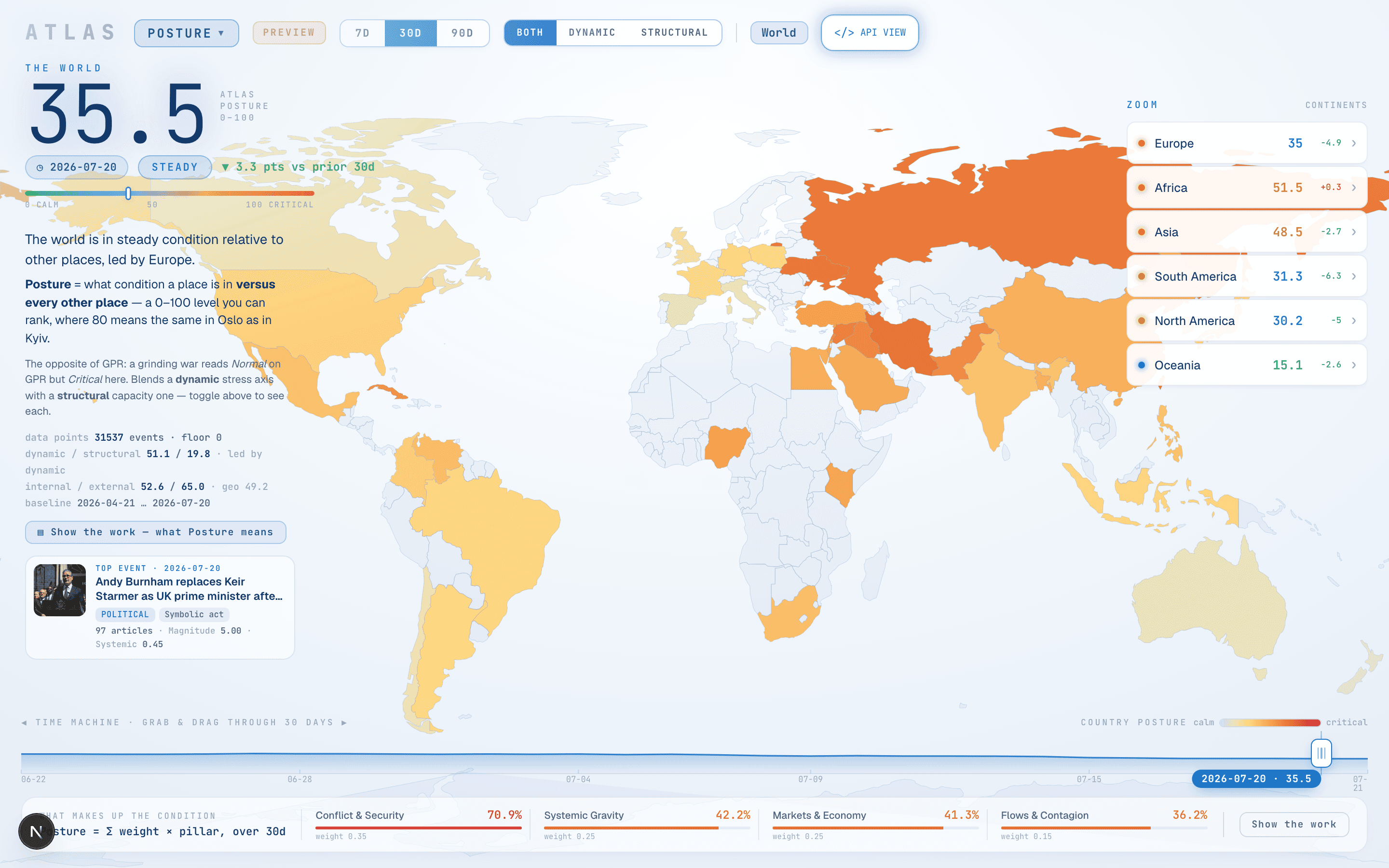
An absolute 0–100 level you can rank: Calm below 20, Steady 20–40, Elevated 40–60, High 60–80, Critical at 80 and above. 80 means the same thing in Oslo as in Kyiv.
The formula
Posture = Σ (pillar score × weight) over 30 days · Conflict & Security 0.35 + Systemic Gravity 0.25 + Markets & Economy 0.25 + Flows & Contagion 0.15A real reading
On 2026-07-20 the world read 35.5 — Steady. Africa 51.5 and Asia 48.5 sat well above it, Oceania 15.1 well below. Conflict & Security was the heaviest pillar at 70.9%.
Two ways to run it
Dynamic
The four event-derived pillars — what is happening to a place right now, recomputed daily.
Structural
The standing condition a country brings to any week: governance and rule of law, how democratic the regime is, development and economic structure. Annual and lagged by design — it describes the ground a shock lands on.
How ours differs
- The established fragility indices are expert-scored once or twice a year. This recomputes daily off an event feed.
- Pillar weights and band cut-points are published, so a score can be argued with rather than taken on trust.
- Scored against fixed real-world anchors rather than a live ranking, so an aggregate can actually move.
- Governance and democracy are separate dimensions, because they come apart routinely.
- The design decision worth knowing
- A rank is zero-sum: it pins every aggregate mid-scale whatever is happening, and lets a country improve only because another got worse. Anchoring to fixed reference points means a country’s score depends only on its own condition.
From GDELT Cloud
- Coded events, split internal and external by whether actors sit inside one country or span a border
- Fatalities and civilian targeting from conflict events
- Entity resolution, so actors attribute to the right country
From open feeds
- World Bank — Worldwide Governance Indicators, for governance and rule of law
- V-Dem — electoral, liberal, civil-liberties and free-expression indices
- World Bank WDI — development and economic structure, and GDP for roll-up weighting
Frameworks it draws on
- ICRG — PRS Group
- The composite-with-published-sub-weights structure, and the discipline of holding band cut-points fixed so a band change is itself the news.
- FSI / CAST — Fund for Peace
- The precedent that media content analysis is a legitimate primary input to fragility scoring. CAST does it with Boolean searches over articles; we do it event-coded and daily.
- GPI — Institute for Economics & Peace
- The internal-versus-external split, which is why every pillar here carries both readings.
- INFORM — EC Joint Research Centre
- The triad: a slow structural baseline, a live warning signal and active-crisis severity as separate layers. That separation is exactly Posture versus GPR.
- OECD / JRC Handbook on Composite Indicators
- The audit standard a composite gets held to — published weights, stated compensability, and sensitivity to the weighting choice.
Where it stands today
Around 60 countries clear the coverage floor over a 30-day window, and world and continent roll-ups are solid. Thinner geographies are withheld rather than guessed. A fifth pillar, Narrative & Information, is specified and named as deferred in every response until its inputs are dense enough to earn a place.
CNP — Comprehensive National Power
In developmentHow much weight can a state actually bring to bear?
- The idea
- A composite of national capability — economic, military, technological and diplomatic weight — paired with a behavioural layer asking whether influence is actually rising or falling. Structural stocks move annually; behaviour moves monthly.
- Why it is not here yet
- The capability inputs are annual, lagged and unevenly reported, and a composite is only as honest as its weakest pillar.
No screenshot — this layer isn't built yet, and we'd rather show you nothing than a mockup of something that doesn't run.
Frameworks it draws on
- Chinese CNP lineage — AMS, CASS, CICIR
- The tradition that formalised national power as a weighted composite, and the source of the pillar vocabulary.
- CINC
- The share-of-world convention — power as a fraction of the global total rather than an absolute score.
- Lowy Asia Power Index
- Separates the resources a country holds from the influence it actually exercises.
- Beckley — net power
- The correction that gross size overstates power; costs have to be netted out.
Where it stands today
Designed and researched, not serving. Nothing is returned by the API for this layer today.
Vane
In developmentPoint the index at your question instead of at a map.
- The idea
- Exposure, risk and stance conditioned on an entity or a standing question — a company, a commodity, a corridor, a country pair — rather than on a geography.
- Why we want it
- The research behind this layer found roughly 90% of political-risk variation is entity-level rather than country- or sector-level. Almost nobody’s risk is actually shaped like a country.
- Why it is not here yet
- A conditioned index inherits every identity error beneath it and amplifies them, so it gates on entity resolution being right rather than merely good.
No screenshot — this layer isn't built yet, and we'd rather show you nothing than a mockup of something that doesn't run.
Frameworks it draws on
- PRisk — Hassan, Hollander, van Lent & Tahoun (QJE 2019)
- Firm-level political risk from earnings-call text, validated against what firms subsequently lobbied on. Keeps risk, sentiment and exposure as three separate axes — so would we.
- GeoQuant (Fitch) — contingent risk
- The commercial precedent for bilateral, pair-conditioned scores rather than single-country ones.
- Metaculus / Tetlock question grammar
- The Clairvoyance Test: a standing question is only worth scoring if a clairvoyant could resolve it unambiguously.
Where it stands today
Designed and researched, not serving. Nothing is returned by the API for this layer today.
Forecast
In developmentPredictions, with the scorecard attached.
- The idea
- Dyadic escalation forecasts — the probability that a given pair of actors escalates within a horizon — published behind a permanent public scorecard.
- Why the scorecard comes first
- Forecasts are cheap to publish and expensive to be held to. The accuracy record ships on day one and stays up whether or not it flatters us.
- Why it is not here yet
- The coded record begins in March 2026 — not yet enough history to backtest honestly, and a forecast you cannot backtest is an opinion with a decimal point.
No screenshot — this layer isn't built yet, and we'd rather show you nothing than a mockup of something that doesn't run.
Frameworks it draws on
- ViEWS — Uppsala / PRIO
- The dual-number pattern: an expected magnitude and a probability of crossing a named threshold, evaluated publicly every cycle.
- ACLED CAST
- Always plots forecast against observed, so the track record sits in the same chart as the claim.
- PITF — Goldstone et al.
- Parsimony is credibility: four variables reached roughly 80% accuracy. A small defensible model beats a large opaque one.
- Goldstein & Freeman — dyadic reciprocity
- Established that event data can measure action and response between actor pairs, which is the unit this layer would forecast on.
Where it stands today
Designed and researched, not serving. Nothing is returned by the API for this layer today.
Coverage Atlas · where the indices are servable
We publish exactly where we have depth — and where we don't.
Every country here is coloured by the coded-event coverage we actually have over the last 30 days, from our own events — the same coverage the Atlas floors gate on. Below the floor a country returns null, not a guessed score. Of 242 countries, 131 carry enough density to serve a country-level condition reading and 52 clear the higher bar for a daily tension reading; the rest are shown thin or empty rather than filled with a confident number.
The servable set — 131 countries, densest first
A dot marks the 52 countries dense enough for a daily tension reading too. Query it yourself: GET /api/v2/intelligence/coverage?tier=depth
Over the API · Intelligence plan
GET /api/v2/intelligence/gprGET /api/v2/intelligence/postureGET /api/v2/intelligence/coverage