
Significance
43 measured / 43 eligible · 0 missing · 0 not applicable
score (0 to 1) · Event-level distribution, not a Situation risk score.
across all 43 events
SituationPortugal
On 27 October, António José Seguro criticized police conduct during the housing protests, while “Portugal's Ombudsman to review police actions at housing protests” described an Ombudsman review and an injured Amnesty International observer. On 28 October, Porto’s popular assembly voted to bring back its camp, while more than 200 demonstrators revived an encampment in central Lisbon. On 2 November, a Lisbon court allowed a protest tent to remain at Rossio until 25 November; the Ministério Público appealed a permit concerning Renata Cambra on 3 November, and a Lisbon court suspended Cambra’s right to remain at the camp on 9 November. Lisbon Municipal Police moved to remove Acampada de Lisboa tents at Rossio on 6 November, and the encampment removed its tents and decentralized its protest on 10 November. Housing-rights protesters demonstrated across Portuguese cities on 14 November, when José Luís Carneiro praised Seguro after a meeting with housing protesters; on 18 November, the government planned a meeting with Porto protesters. On 19 November, Porta a Porta demanded political accountability from the PSP and André Ventura accused the Ombudsman of bias over the protest report. The Ombudsman said police struck non-resisting protesters with batons in “Portugal Ombudsman says police struck non-resisting protesters with batons”; the PSP denied baton abuse in “Portugal police deny
Footnotes[32][28][43][26][49][27][35][22][20][31][17][37]The Lisbon and Porto camps involved separate actions and legal proceedings; the Rossio permission for a tent and the later suspension of Cambra’s protection concern distinct proceedings, not a single resolution for all camps. The Ombudsman’s account of baton use and the PSP’s denial remain competing attributed positions, and Ventura’s accusation is a political response rather than a finding about the Ombudsman’s report. The inspectorate and prosecutorial inquiries establish scrutiny, not findings of responsibility; the government’s stated plan to meet Porto protesters establishes intent, not a completed meeting or resolution of their demands. The demonstrations, Rossio actions, and Porto case therefore establish multiple strands of housing mobilization and response, not one continuous encampment or a final legal outcome.
Footnotes[35][31][2][1][36][29][40][39][34][45]Explanation originally captured 2026-11-24 · Evidence through 2026-11-25 UTC · Source edition sed_a6407d82e2973f2504cda0288854cb7e
A 27-day Situation represented by 43 coded Events carried across 151 member Stories.
The coded activity is led by PEACEFUL PROTEST (21) and PROTEST WITH INTERVENTION (4).
António José Seguro, Polícia de Segurança Pública, and Renata Cambra are prominent in the retained actor and relationship evidence.
182 canonical Entities are linked to this edition.
Metric coverage. 43 coded Events · 18 CAMEO+ · 25 conflict. The four dimensions describe the CAMEO+ subset; conflict Events do not carry these scores.
Dot = mean · shaded span = observed range · position uses each metric’s defined scale.
How the coder scored the full retained Event set
43 coded events — 18 CAMEO+ (16 political) · 25 conflict
Quad class over those 41 events · Verbal Conflict 27 · Verbal Cooperation 8 · Material Conflict 5 · Material Cooperation 1. 2 sit outside POLITICAL, where Goldstein and quad class are undefined. The four CAMEO+ scores are over the 18 CAMEO+ events only; the 25 conflict events have no such column.
43 measured / 43 eligible · 0 missing · 0 not applicable
score (0 to 1) · Event-level distribution, not a Situation risk score.
across all 43 events
18 measured / 18 eligible · 0 missing · 25 not applicable
score (0 to 10) · Event-level distribution, not a Situation risk score.
across the 18 of 43 events coded in the CAMEO+ family; the conflict family has no such column
18 measured / 18 eligible · 0 missing · 25 not applicable
score (0 to 1) · Event-level distribution, not a Situation risk score.
across the 18 of 43 events coded in the CAMEO+ family; the conflict family has no such column
18 measured / 18 eligible · 0 missing · 25 not applicable
score (0 to 1) · Event-level distribution, not a Situation risk score.
across the 18 of 43 events coded in the CAMEO+ family; the conflict family has no such column
18 measured / 18 eligible · 0 missing · 25 not applicable
score (0 to 1) · Event-level distribution, not a Situation risk score.
across the 18 of 43 events coded in the CAMEO+ family; the conflict family has no such column
41 measured / 41 eligible · 0 missing · 2 not applicable
score (-10 to 10) · Event-level distribution, not a Situation risk score.
across the 41 of 43 events Goldstein is defined on — CAMEO+ POLITICAL and the conflict family; the other nine CAMEO+ domains have no Goldstein semantics
25 measured / 25 eligible · 0 missing · 18 not applicable
reported people · Reports may overlap; these are Event-level reports, not an additive unique human toll.
across the 25 of 43 events that report a toll — the conflict family only, and never 0 on a CAMEO+ event
43 measured / 43 eligible · 0 missing · 0 not applicable
score (0 to 1) · Event-level distribution, not a Situation risk score.
across all 43 events
This retained edition, independent of graph and page limits. Different dimensions, not a blended risk score; reported tolls may overlap.
2026-11-20from the recordslatest
Portugal police deny baton abuse during housing protest camp eviction in Lisbon
3 Stories and 0 coded Events (+1 / -3 against the day before). Widest coverage: Portugal police deny baton abuse during housing protest camp eviction in Lisbon (1 articles).
What kind of event · 14 coded types
over 43 coded events on this edition
Countries · where it happened
Countries · who is acting
Selected from the complete retained edition
Stories describe camp activity in Lisbon and Porto, nationwide housing demonstrations, and the later Lisbon encampment at Restauradores Square.
Stories describe a court permission for a Rossio tent, a separate court action concerning Renata Cambra, and municipal orders and actions concerning the encampment.
Stories describe disputed police conduct, an inspectorate inquiry, prosecutorial investigations, and the Ombudsman’s account alongside the PSP’s denial.
Stories describe Seguro’s engagement with housing groups, Carneiro’s response, the Liberal Initiative’s position, and the government’s stated plan to meet Porto protesters.
António José Seguro criticized police conduct, was the target of housing groups’ scheduled meeting, and was praised by José Luís Carneiro after the housing-protest meeting.
Polícia de Segurança Pública made a public statement that media drones could fly at Rossio demonstrations.
Polícia de Segurança Pública made a public statement that media drones could fly at Rossio demonstrations.
Footnotes[50]Renata Cambra was the target of the court action suspending her camp protection.
Renata Cambra was the target of the court action suspending her camp protection.
Footnotes[31]José Luís Carneiro praised António José Seguro after the housing-protest meeting.
José Luís Carneiro praised António José Seguro after the housing-protest meeting.
Footnotes[45]Chega urged Seguro to publicly support police intervention.
Chega urged Seguro to publicly support police intervention.
Footnotes[46]
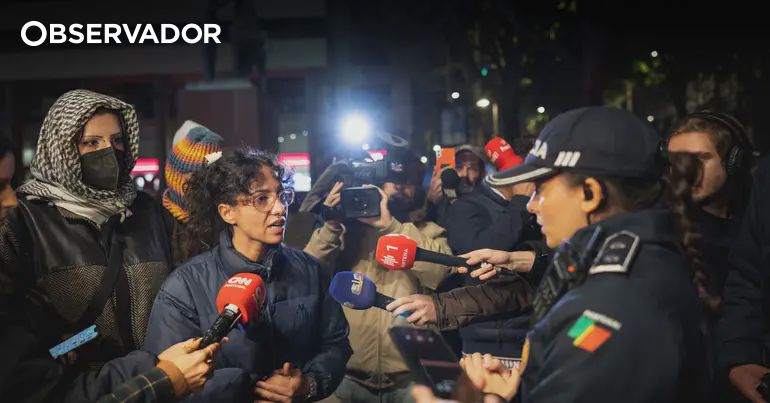

The Event describes PSP dispersing Acampada do Porto protesters on 1 November, while its linked Story headline describes a Lisbon encampment at Rossio.

Evidenced relationships involving significant participants beyond the central cast.
The Event identifies Polícia de Segurança Pública as its source actor.
The Event identifies Carneiro as its source actor and Seguro as its target.
The Event identifies the Liberal Initiative as its source actor.
This edition freezes the complete served membership and analysis available through its UTC cutoff. Later repairs or identity changes do not rewrite what this edition showed.
Stories are reporting clusters. Events are coded occurrences within that reporting. The cast contains 182 canonical people and organizations linked to the retained evidence.
Story-to-Event edges identify supporting reporting. Entity-to-Event edges identify recorded actor or target participation. Mentions and analytical roles stay visibly distinct from recorded participation.
Core, precursor, and continuation labels organize the reading. They do not by themselves establish causation. Collapsed graph groups and paginated evidence change presentation only; counts use the complete retained edition.