
Significance
38 measured / 38 eligible · 0 missing · 0 not applicable
score (0 to 1) · Event-level distribution, not a Situation risk score.
across all 38 events
On September 29, French students blocked high schools and clashed with French police; the September 30 headline “French student protests disrupt 400 high schools; 440 arrested” reported the scale of disruption and arrests. Students of Antoine-de-Saint-Exupéry High School blocked gates in Fameck to demand more resources, while the October 1 headline “Hundreds of students block Pau high schools over funding and workload” reported separate grievances in Pau. On September 30, police fired tear gas as students threw stones in Mulhouse, and Lycée Diderot demonstrators clashed with French police in Lyon. On October 1, an Event described French police firing tear gas at protesting high-school students in Toulouse, while “French student protests escalate, leaving 202 injured and hundreds detained” reported injury and detention figures. Valérie Pécresse sought lycée-damage reimbursement from Bally Bagayoko in an Event dated September 29; the September 30 Story “Pécresse seeks €100,000 from Saint-Denis mayor over school blockade damage” reported the amount she sought.
Footnotes[15][6][18][5][13][17][10][14][1][12][9]The nationwide blockade coverage is supported by local Events describing both a peaceful blockade outside a Cherbourg school and clashes in Mulhouse and Lyon; these incidents do not establish that all participants or actions were violent. Fameck students’ demand for more resources and the Pau headline’s funding-and-workload concerns establish reported local grievances, not a shared demand among all students. “France opens three IGPN investigations into violence at high school blockades” establishes that investigations were reported, not their findings. The public-sector-protest headline is linked in the packet to the same nationwide protest reporting, while a separately coded Paris Event describes public-sector workers demonstrating against pension reform on September 29; the records do not establish that every public-sector demonstration was part of the school blockades. The injury and detention figures in the September 30 and October 1 headlines have different reporting dates and are not reconciled here, while Pécresse’s reimbursement demand does not establish Bagayoko’s responsibility for damage.
Footnotes[16][13][17][18][5][4][8][6][1][12][9]Explanation originally captured 2026-10-02 · Evidence through 2026-10-02 UTC · Source edition sed_500ba96039bd83e63603882f9868ec3c
A 4-day Situation represented by 38 coded Events carried across 62 member Stories.
The coded activity is led by PEACEFUL PROTEST (15) and VIOLENT DEMONSTRATION (15).
🇫🇷France and 🇧🇪Belgium are prominent in the retained actor and relationship evidence.
140 canonical Entities are linked to this edition.
Metric coverage. 38 coded Events · 2 CAMEO+ · 36 conflict. The four dimensions describe the CAMEO+ subset; conflict Events do not carry these scores.
Dot = mean · shaded span = observed range · position uses each metric’s defined scale.
How the coder scored the full retained Event set
38 coded events — 2 CAMEO+ (1 political) · 36 conflict
Quad class over those 37 events · Material Conflict 21 · Verbal Conflict 16. 1 sit outside POLITICAL, where Goldstein and quad class are undefined. The four CAMEO+ scores are over the 2 CAMEO+ events only; the 36 conflict events have no such column.
38 measured / 38 eligible · 0 missing · 0 not applicable
score (0 to 1) · Event-level distribution, not a Situation risk score.
across all 38 events
2 measured / 2 eligible · 0 missing · 36 not applicable
score (0 to 10) · Event-level distribution, not a Situation risk score.
across the 2 of 38 events coded in the CAMEO+ family; the conflict family has no such column
2 measured / 2 eligible · 0 missing · 36 not applicable
score (0 to 1) · Event-level distribution, not a Situation risk score.
across the 2 of 38 events coded in the CAMEO+ family; the conflict family has no such column
2 measured / 2 eligible · 0 missing · 36 not applicable
score (0 to 1) · Event-level distribution, not a Situation risk score.
across the 2 of 38 events coded in the CAMEO+ family; the conflict family has no such column
2 measured / 2 eligible · 0 missing · 36 not applicable
score (0 to 1) · Event-level distribution, not a Situation risk score.
across the 2 of 38 events coded in the CAMEO+ family; the conflict family has no such column
37 measured / 37 eligible · 0 missing · 1 not applicable
score (-10 to 10) · Event-level distribution, not a Situation risk score.
across the 37 of 38 events Goldstein is defined on — CAMEO+ POLITICAL and the conflict family; the other nine CAMEO+ domains have no Goldstein semantics
36 measured / 36 eligible · 0 missing · 2 not applicable
reported people · Reports may overlap; these are Event-level reports, not an additive unique human toll.
across the 36 of 38 events that report a toll — the conflict family only, and never 0 on a CAMEO+ event
38 measured / 38 eligible · 0 missing · 0 not applicable
score (0 to 1) · Event-level distribution, not a Situation risk score.
across all 38 events
This retained edition, independent of graph and page limits. Different dimensions, not a blended risk score; reported tolls may overlap.
2026-10-02from the recordslatest
French students set trash bins ablaze and throw projectiles at police
13 Stories and 4 coded Events (-16 / -17 against the day before). Widest coverage: Student protests disrupt over 1,000 schools across France, with fires and injuries (87 articles).
What kind of event · 7 coded types
over 38 coded events on this edition
Countries · where it happened
Countries · who is acting
Selected from the complete retained edition
National blockade coverage is accompanied by Events describing a nationwide clash and local police encounters in Mulhouse, Lyon, and Toulouse; the Cherbourg Event describes a peaceful blockade.
The Fameck Event identifies a demand for more resources, and the Pau headline reports concerns about funding and workload.
A Marseille Event describes unidentified assailants dousing a school principal and staff with gasoline, and an October 1 headline reports three IGPN investigations into blockade violence.
Public-sector protest coverage and Pécresse’s reimbursement demand are distinct from the established student-police incidents.

Dated September 29, this Event describes French students blocking high schools and clashing with French police.
Dated September 29, this Event describes French students blocking high schools and clashing with French police.
Footnotes[15]
Dated September 29, this Event describes Fameck students blocking gates to demand more resources.
Dated September 29, this Event describes Fameck students blocking gates to demand more resources.
Footnotes[18]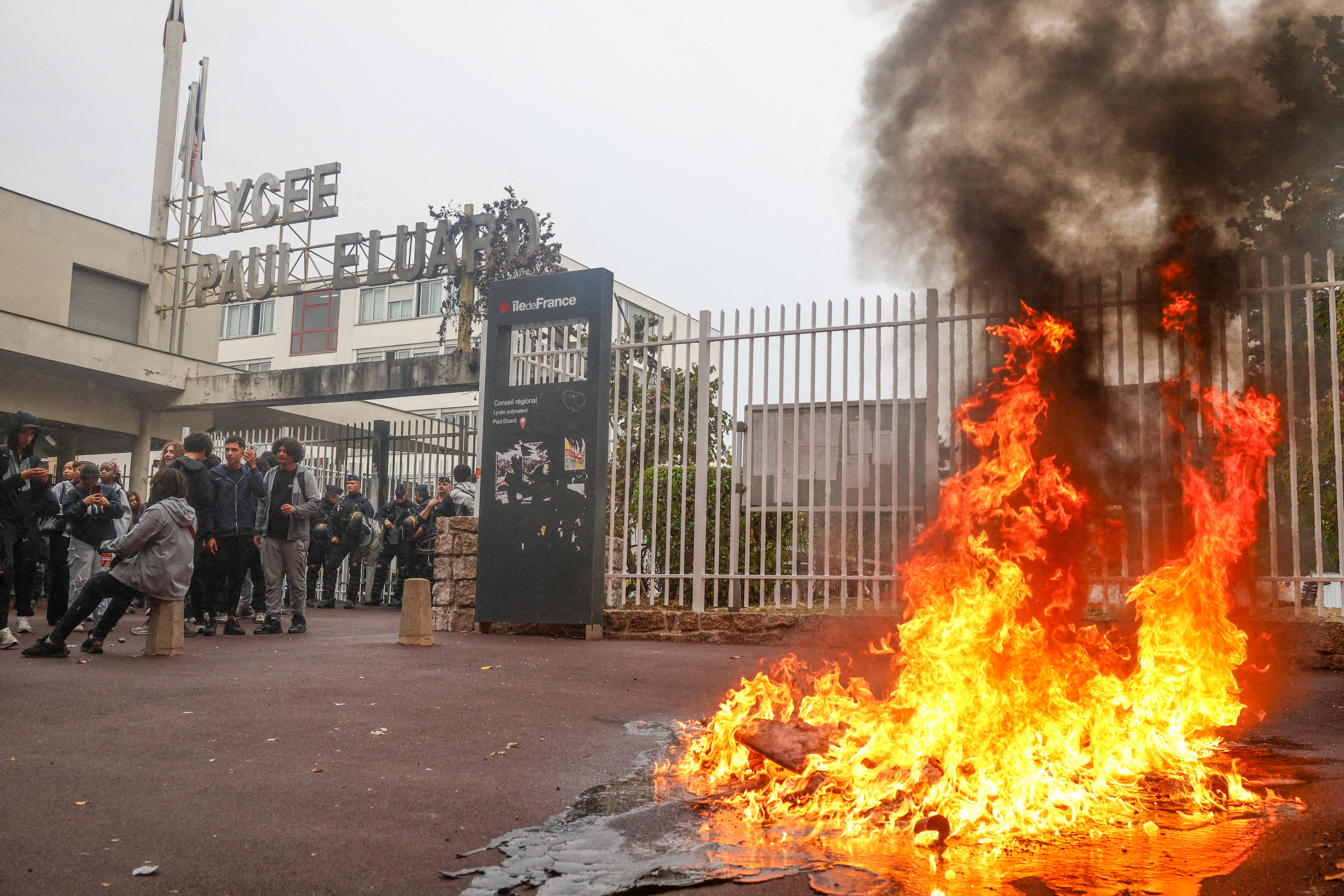
Dated September 29, this Event describes Valérie Pécresse seeking reimbursement from Bally Bagayoko for lycée damage.
Dated September 29, this Event describes Valérie Pécresse seeking reimbursement from Bally Bagayoko for lycée damage.
Footnotes[12]Dated September 30 in Mulhouse, this Event describes police firing tear gas as students threw stones.
Dated September 30 in Mulhouse, this Event describes police firing tear gas as students threw stones.
Footnotes[13]
Dated September 30 in Lyon, this Event describes Lycée Diderot demonstrators clashing with French police.
Dated September 30 in Lyon, this Event describes Lycée Diderot demonstrators clashing with French police.
Footnotes[17]Evidenced relationships involving significant participants beyond the central cast.
The Event lists the Story as supporting coverage.
The Event lists the Story as supporting coverage.
The Event lists the Story as supporting coverage.
The Event lists the Story as supporting coverage.
The Event lists the Story as supporting coverage.
This edition freezes the complete served membership and analysis available through its UTC cutoff. Later repairs or identity changes do not rewrite what this edition showed.
Stories are reporting clusters. Events are coded occurrences within that reporting. The cast contains 140 canonical people and organizations linked to the retained evidence.
Story-to-Event edges identify supporting reporting. Entity-to-Event edges identify recorded actor or target participation. Mentions and analytical roles stay visibly distinct from recorded participation.
Core, precursor, and continuation labels organize the reading. They do not by themselves establish causation. Collapsed graph groups and paginated evidence change presentation only; counts use the complete retained edition.